The stories that bind us,
and the Wholeness we have forgotten
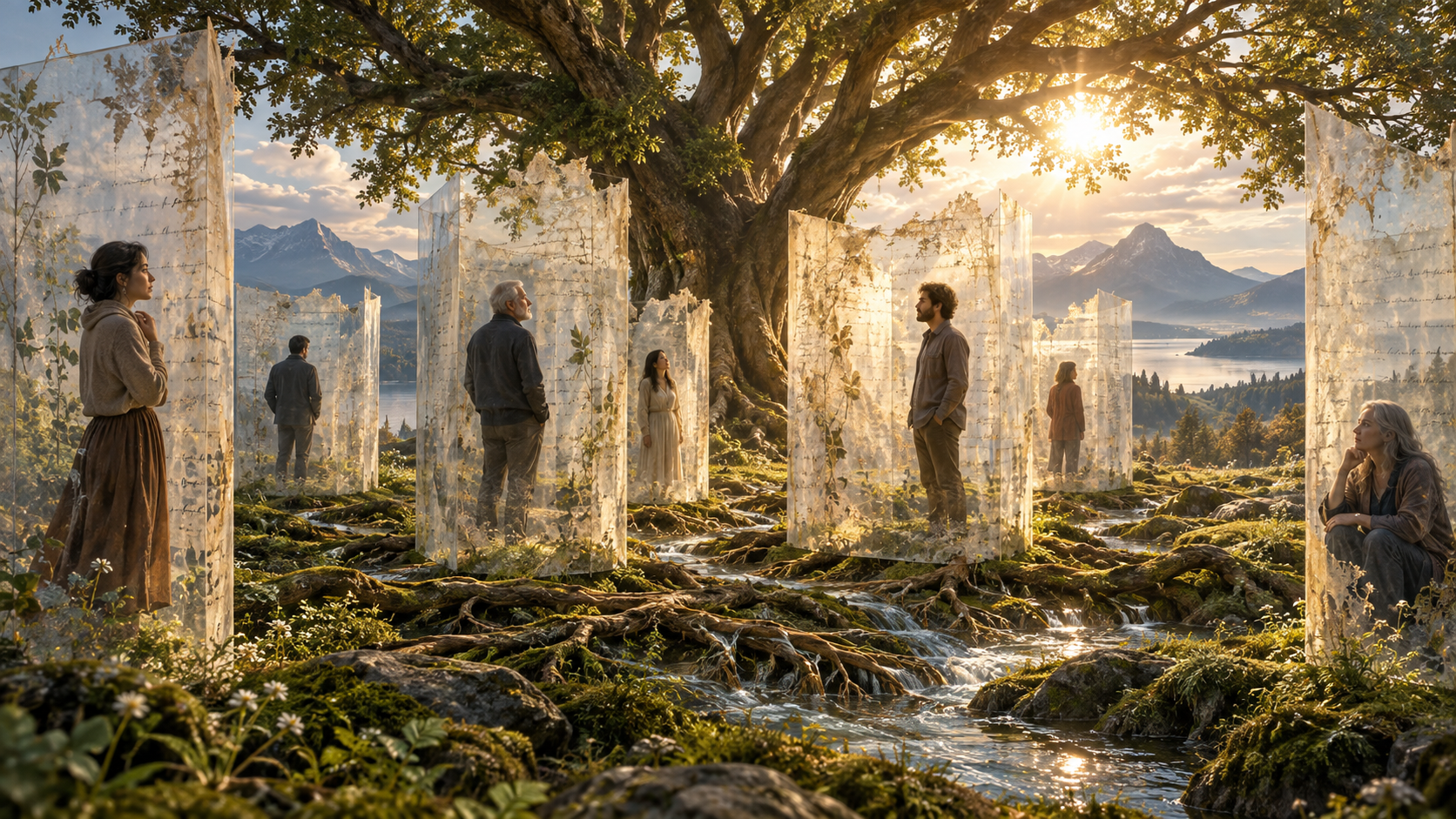
Homo sapiens are storytellers. Yet stories are simply stories; they are not reality. We may come to believe a story is true, failing to recognize what it points toward or that it can never be identical to what it represents. A peculiar magic resides in the stories we tell—not only those shared beside ancient fires, carried across generations, or written in books, but also the subtle, painful, conditioned narratives we absorb without question about ourselves and the world.
These stories settle into the hidden chambers of our consciousness, shaping how we see, how we love, what we fear, and what we believe we must become. Some stories awaken us to the wonder of existence, inviting us into a deeper relationship with the living world. Others become invisible walls, separating us from one another, from the Earth, and ultimately from the very nature of our own being. Perhaps the most powerful story of all is the one that tells us something essential is missing—that we are somehow incomplete.
In J.R.R. Tolkien’s The Lord of the Rings, this story finds an extraordinary expression in a small golden ring. At first glance, the Ring appears to be an object of immense power, capable of rendering its bearer invisible, unnaturally prolonging life, and drawing even the wisest beings toward its seductive promises. Yet beneath these powers lies something more intimate, something that reaches into the hidden vulnerabilities of the human heart. The Ring awakens the longing to become more than we believe ourselves to be. It whispers to our insecurities, magnifies our fears, and promises that through possession, recognition, power, and control, we might finally find the security and completeness we have been searching for. The more deeply we believe its promises, the more completely we surrender to them.
Sauron, the Dark Lord, forged the Ring, and his hunger for dominion has become inseparable from his existence. Through it, he seeks to bend the living world to his will, replacing its wild and unpredictable beauty with an order organized around his own power. In this sense, Sauron becomes a compelling embodiment of manipulation, control, and deception. Not a deception in the simplistic sense that the world is unreal or meaningless, but a deeper misperception through which we experience ourselves as fundamentally separate from the life of which we are an expression. Within this illusion, existence becomes something to conquer rather than participate in. The Earth becomes a resource, other beings become competitors or possessions, and the self becomes a fragile identity that must continually be defended. Sauron represents this forgetting carried to its most destructive extreme: the desperate desire to possess the world because one has forgotten how to belong to it.
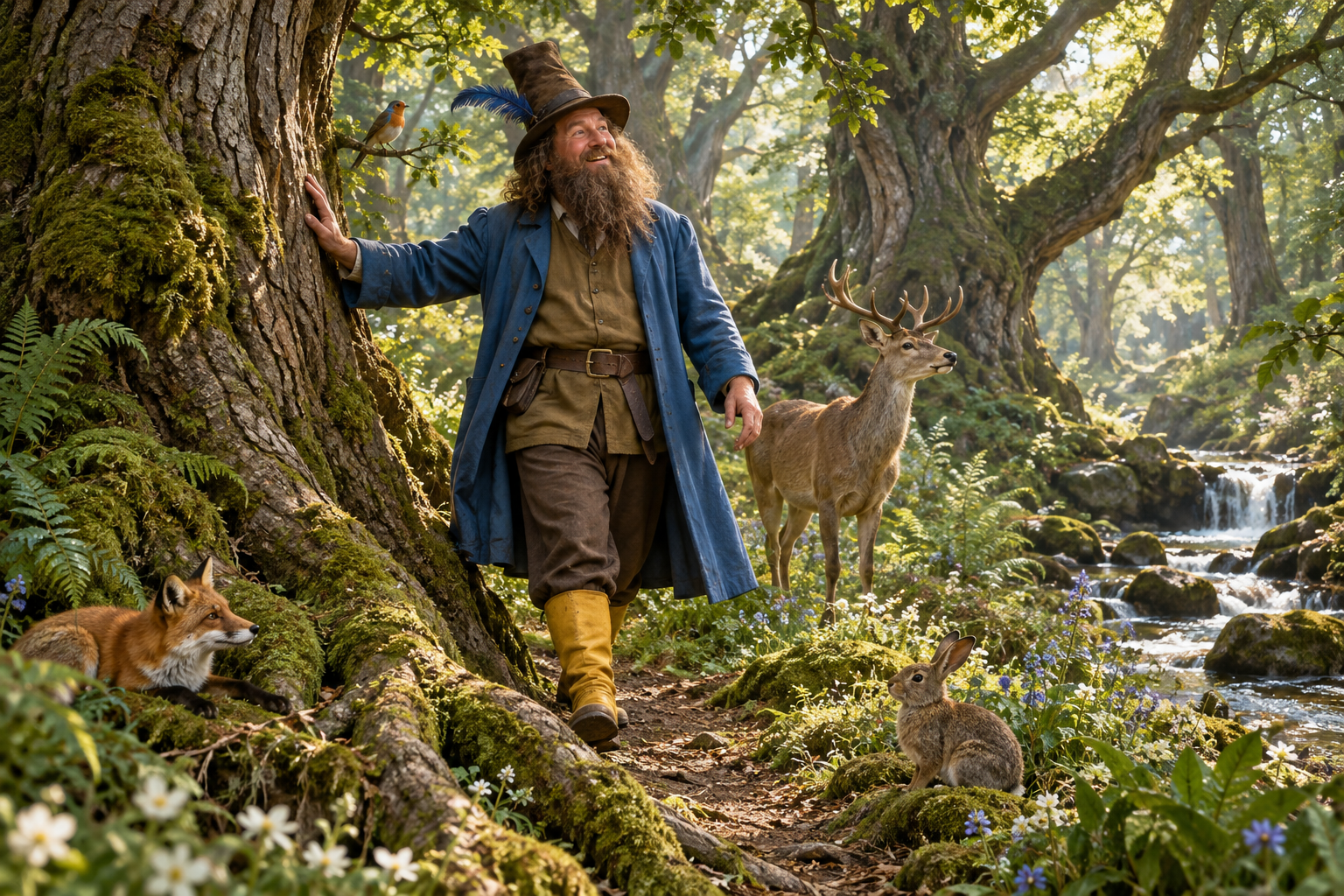
Yet Tolkien, with the wisdom of a storyteller who understood the mysteries of the human condition, offers us another possibility. Deep within the ancient forests of Middle-earth lives a curious and joyful being named Tom Bombadil. He moves through the woods singing, delighting in the flowing rivers, the turning seasons, the trees, the rain, and the countless creatures with whom he shares his home. His existence feels wonderfully unburdened, as though he belongs so completely to the world that he has never thought to possess it. His relationship with nature is not one of ownership or dominion, but of intimacy, participation, and delight. He seems to move within the rhythms of life rather than attempting to bend them to his desires.
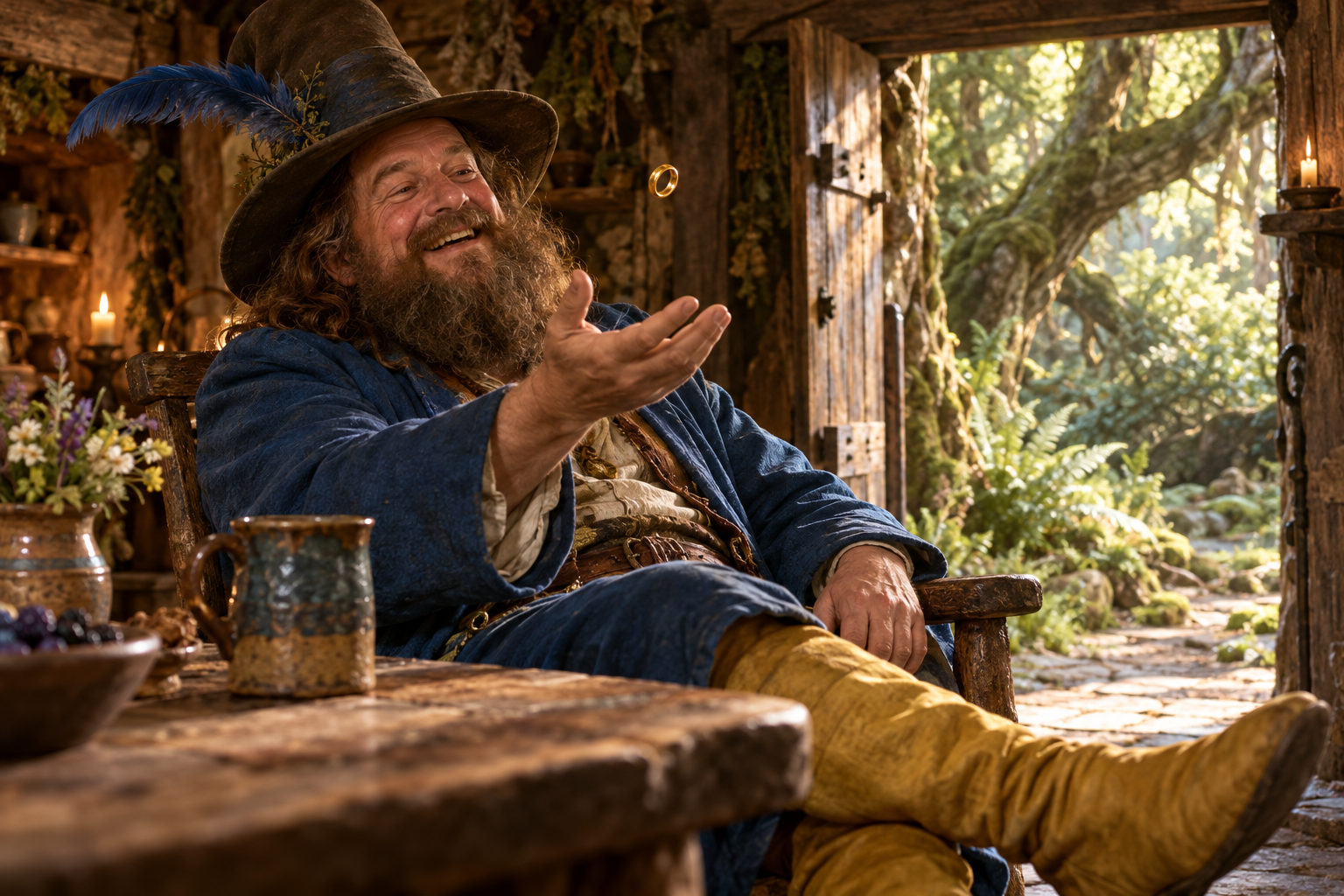
When Frodo encounters Tom Bombadil, something remarkable happens. Frodo gives him the Ring, and Tom places it upon his finger. Yet nothing happens. He does not disappear, nor does he become intoxicated by its promises. He laughs, plays with it, and eventually returns it to Frodo, seemingly untouched by the power that has corrupted kings, warriors, and even the most well-intentioned beings. What about this strange, singing forest inhabitant renders the Ring powerless? Perhaps Tom doesn't need what the Ring promises. He does not seek to become greater than he is, nor does he imagine that his existence requires something beyond the life already unfolding around him. He has no desire to stand above the world because he knows he belongs within it. Tom is inseparable from nature, from the whole. He is Wholeness realized.
When the hobbits learn that Tom is master of the wood, the water, and the hill, they encounter a meaning of mastery unlike Sauron's. Tom’s freedom does not arise from control. As Goldberry explains, the living things of his country belong to themselves. What a beautiful distinction. To belong to the world is not to own it. To love something is not to possess it. And to experience Wholeness is not to become master of existence, but to recognize that we have never stood apart from the web of relationships through which life expresses itself. In this reading, Tom Bombadil embodies Wholeness—not a perfected personality, nor a being who has accumulated sufficient knowledge or power, but one who is free from the belief that he must acquire something to be complete. He is at home in existence, so the Ring offers him nothing. He is truly whole.
This does not make Tom invulnerable to every danger, nor does it mean he could defeat Sauron. His freedom is of another kind, one that stands quietly outside the struggle for possession. That's why his presence feels so extraordinary to me. He reminds us that there is another way to inhabit the world, another way to love, another way to be alive. One can participate without needing to dominate, cherish without needing to possess, and belong without first having to become something else. Tom is not struggling to return to wholeness. He is living within it, as naturally as the river flows toward the sea or the trees reach toward the sun.
But most of Middle-earth's inhabitants have forgotten this possibility, and nowhere is that forgetting more heartbreaking than in the story of a creature once known as Sméagol.
Long before Frodo and Sam encounter him, Sméagol discovers the Ring and becomes consumed by its promises. What begins as desire slowly becomes the organizing principle of his existence. He murders to possess it, withdraws from relationships, and retreats into the shadows, where the passing centuries gradually erode his memory. His body changes, his world grows smaller, and his identity becomes inseparable from the object he calls his Precious. Eventually, even his name is transformed. Sméagol becomes Gollum, a creature whose existence has narrowed into an endless hunger for something he believes he cannot live without. He imagines he possesses the Ring, yet his longing for it possesses him.
Perhaps this is the tragedy of the insecure, enculturated self. We arrive in the world utterly dependent on relationships, belonging to a vast, intricate web of life that sustains us before we learn to name it. Yet as we grow, we begin to inherit stories about who we must become. We learn that love may depend upon our behavior, that our worth can be measured, that belonging must be earned, and that happiness waits somewhere beyond who we already are. We learn to compare ourselves, compete, defend the identities we construct, and search endlessly for something that might finally quiet the uneasy feeling that we are not enough. Gradually, these stories become so familiar that we no longer recognize them as stories. They become the lens through which we perceive reality, and like Gollum, we begin searching outside ourselves for something we have been taught to believe is missing within.
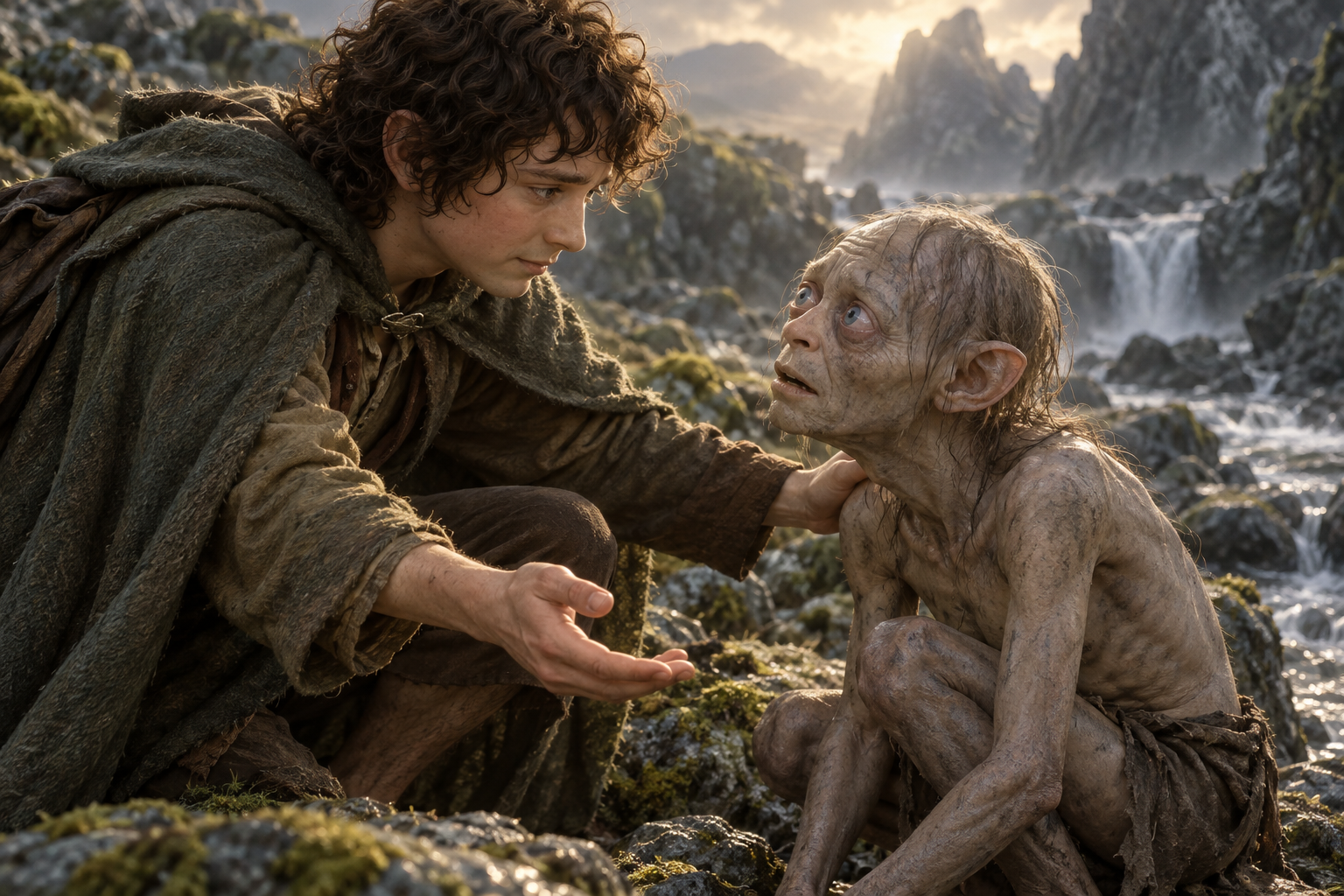
Then something extraordinary happens when Frodo Baggins meets Gollum. Frodo and his faithful companion, Samwise Gamgee, make their way toward the distant fires of Mount Doom, where they must destroy the Ring. Separated from the Fellowship, they travel through a wilderness of gathering darkness, carrying a burden that grows heavier with each passing day. Yet they soon discover that they are not alone. Something has been following them through the shadows, a creature drawn by an ancient longing that has never loosened its hold. Gollum has found them, and he wants his Precious back. He offers to guide the hobbits through the dangerous lands ahead, but his help is entangled with deception, his longing for companionship mixed with a desperate hunger to reclaim the Ring.
Sam recognizes the danger almost immediately. His love for Frodo is extraordinary, a devotion expressed through countless acts of courage, sacrifice, tenderness, and steadfast loyalty. Yet love does not make him immune to fear. He has witnessed Gollum’s cunning and knows that trust carries risk. His heart isn't closed to compassion, but his instinct to protect someone he cherishes keeps it guarded. Sam needs time to trust, time to discover whether the danger he senses is real or whether something gentler might be emerging beneath Gollum’s frightening exterior. His caution is understandable, for Gollum has deceived and harmed, and betrayal remains a real possibility.
Frodo, too, knows fear, yet he carries a tenderness that lets him see something Sam struggles to see. He understands the Ring's terrible burden because he feels its influence within himself. He knows how desire can enter the mind quietly, how possession can become longing, and how longing can slowly tighten into a prison. Looking at Gollum, Frodo sees not merely a treacherous creature, but a being who has suffered profoundly under the same enchantment. He recognizes that Gollum is more than the sum of his destructive behavior, more than the frightening appearance and the desperate hunger that have come to define him.
And so Frodo offers something unexpected. He calls him Sméagol. Not Gollum, the name inseparable from centuries of isolation and craving, but Sméagol, the name of a being who once belonged to a community, who once knew sunlight and laughter, who once inhabited the world before desire became the center of his existence. It is as though Frodo’s compassion reaches beneath the accumulated layers of fear and conditioning, touching something almost forgotten. For a brief, fragile moment, Sméagol begins to respond. He wants to help. He wants to be trusted. He begins to experience the possibility that he might belong to something beyond his own hunger, that perhaps there is still a place for him in the world of relationship.
The Ring has not released its hold upon him, and the old patterns of suspicion and craving remain. Yet something else has entered his world: being seen without being entirely condemned. Perhaps this is what love sometimes makes possible. It does not force another being to change, nor does it erase the wounds of the past. It cannot guarantee that fear will dissolve or that the stories we have carried for a lifetime will suddenly disappear. But it can create a space where those stories begin to dissolve, where the identity we have constructed around our suffering no longer feels quite so absolute. In the warmth of another’s recognition, someone who has spent a lifetime believing themselves unworthy of love might begin to wonder whether that belief was ever true.
Something profoundly human lives in the relationship among these three travelers. Gollum is the insecure, conditioned self, desperately seeking safety through possession. Frodo is a kindhearted being whose open heart has opened him to compassion, allowing him to recognize the vulnerability beneath another’s frightening appearance. And Sam is a deeply loving and loyal companion whose tenderness must sometimes find its way through fear. None of them are simply stuck in a binary of good or bad, wise or foolish, loving or unloving. Each reveals something of our own complicated humanity: how we can care deeply and still remain afraid, recognize suffering and still cause it, and long for connection yet retreat behind the defenses we have built to protect ourselves.
For how often do we love someone and still struggle to trust? How often does our desire to protect those we cherish prevent us from seeing another being clearly? How often do memories of betrayal, abandonment, or disappointment become the lens through which we interpret the present? Sam’s fear is not imaginary, nor is it without reason. Gollum has deceived and harmed, and trust cannot be demanded simply because someone longs to receive it. Yet even understandable fear can become a veil when it hardens into certainty about who another person is and who they must always remain. We begin to mistake our understanding of another being for who they are, and in doing so, we may fail to recognize the possibility of change.
The journey takes a tragic turn as the travelers pass through Ithilien and encounter the men of Gondor, led by Faramir. Near the hidden refuge of Henneth Annûn, the men discover Gollum fishing in a forbidden pool, unaware that those watching from above are ready to kill him. Frodo faces an agonizing choice. He can let Sméagol be slain, or he can persuade him to come forward, knowing the men will seize him. To save his life, Frodo must risk destroying the fragile trust that has begun to grow between them.
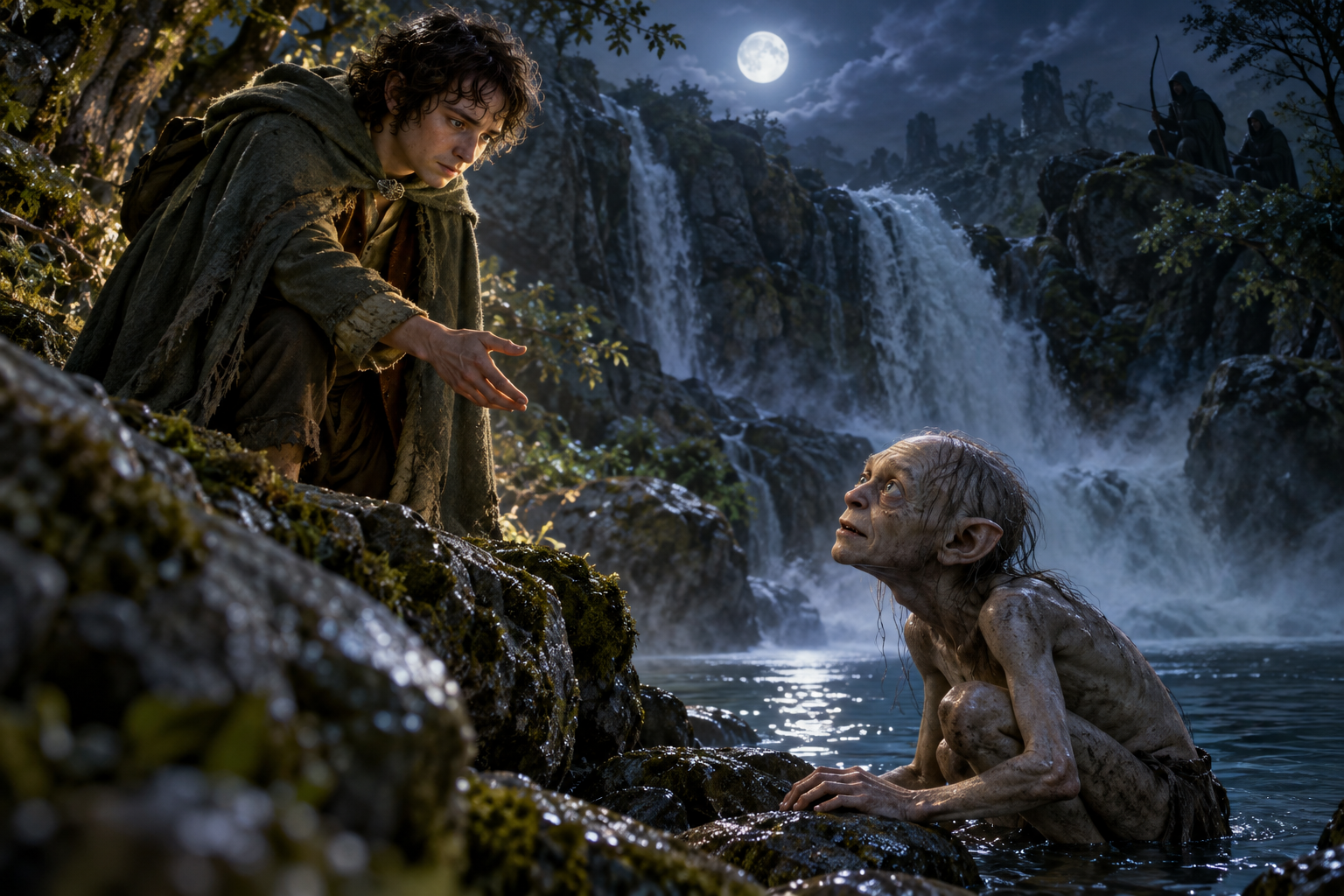
And so Frodo calls to Sméagol. The creature hears the voice of the one person who has shown him genuine tenderness, the one person who has looked beyond the frightening surface and remembered the being beneath. He approaches, believing himself safe, only to find himself suddenly captured and bound. Frodo knows that he has saved Sméagol from death, but Sméagol cannot see what Frodo sees. He does not know the whole story, the danger he has been spared, or the painful choice Frodo has made. He knows only that he trusted, and that trust has led to suffering. The fragile opening within him begins to close, and the old wounds of abandonment, betrayal, and fear rise once more to the surface.
Desperate to explain what happened, the mind reaches for the story it already knows. I was foolish to trust. Kindness is a deception. I am alone. Only the Precious will never abandon me. And in this movement, something painfully familiar unfolds. An experience becomes an interpretation, the interpretation becomes a belief, and the belief begins to shape everything that follows. Sméagol cannot recognize the compassion in Frodo’s apparent betrayal because the pain of being captured has become his whole reality. He sees the event through the accumulated memories and expectations that have shaped his existence, and the story feels so convincing that another understanding becomes almost impossible.
How often does this happen in our own lives? Someone we love makes a choice that hurts us. A friend withdraws, a partner becomes distant, a parent fails to respond as we hoped. And without knowing the whole story, we begin to weave an explanation. Perhaps we are not loved. Perhaps we are not worthy. Perhaps people cannot be trusted, and we must protect ourselves from the vulnerability of belonging. Slowly, the explanation becomes a belief, the belief becomes an identity, and the identity becomes the world through which we experience everything that follows. We no longer simply encounter life as it unfolds; we encounter the stories our minds have learned to interpret it through.
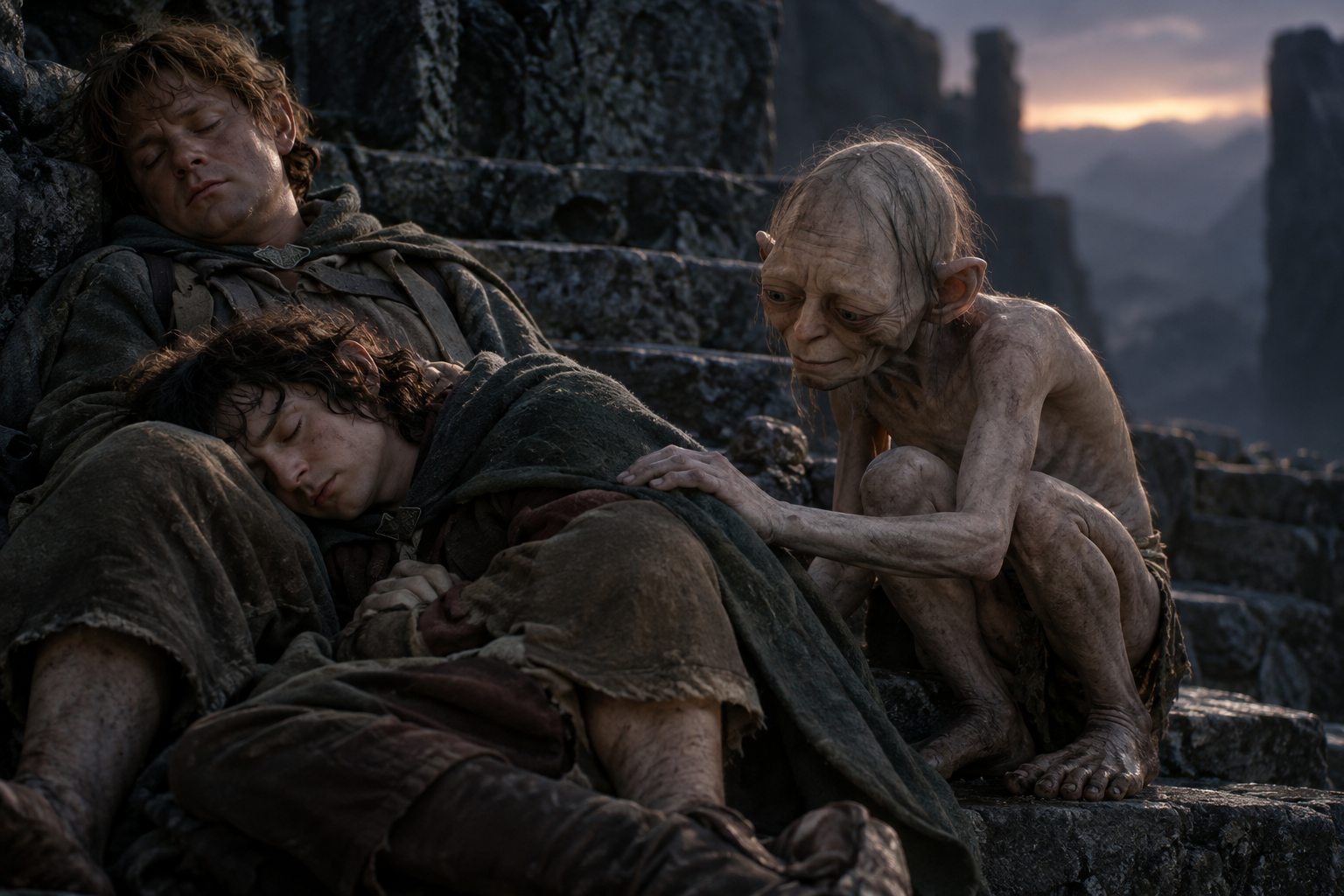
Later, as Frodo and Sam sleep on the stairs above Minas Morgul, Tolkien offers one of the story's most tender and heartbreaking moments. Gollum approaches the sleeping hobbits, and for a fleeting instant, something within him seems to soften. He looks at Frodo with a trace of tenderness, and he reaches toward him with a gesture that almost resembles a caress. For a moment, the ancient creature appears less like Gollum and more like the hobbit-like being he once was. Sméagol is still there, beneath the hunger, beneath the fear, beneath the terrible weight of centuries. The possibility of tenderness has not entirely disappeared.
But Sam awakens and speaks harshly to him, interpreting the gesture through his long-established distrust. The moment passes, and Gollum withdraws once more behind the familiar defenses of resentment and suspicion. It is heartbreaking not because Sam lacks love, for his devotion to Frodo is among the most beautiful expressions of friendship in literature, but because fear, even when born of love, can narrow our ability to see another being’s vulnerability. And Sméagol, so deeply conditioned by insecurity and betrayal, cannot sustain the fragile opening that compassion has made possible. How delicate these moments can be, when a lifetime of fear briefly loosens its grip. How quickly an old story can return, reclaiming the mind before another possibility has had time to take root.
Yet the story is not finished. At last, Frodo and Sam reach the fires of Mount Doom, having endured exhaustion, hunger, terror, and suffering beyond anything they could have imagined. Frodo stands at the edge of the fire where he must destroy the Ring, but at the final moment he cannot let go. Its burden has become too great, its promise too deeply entwined with his sense of self. Even Frodo, whose compassion allowed him to recognize Sméagol’s suffering, is not immune to the illusion. He claims the Ring as his own, and for an instant, the long journey seems to end in failure.
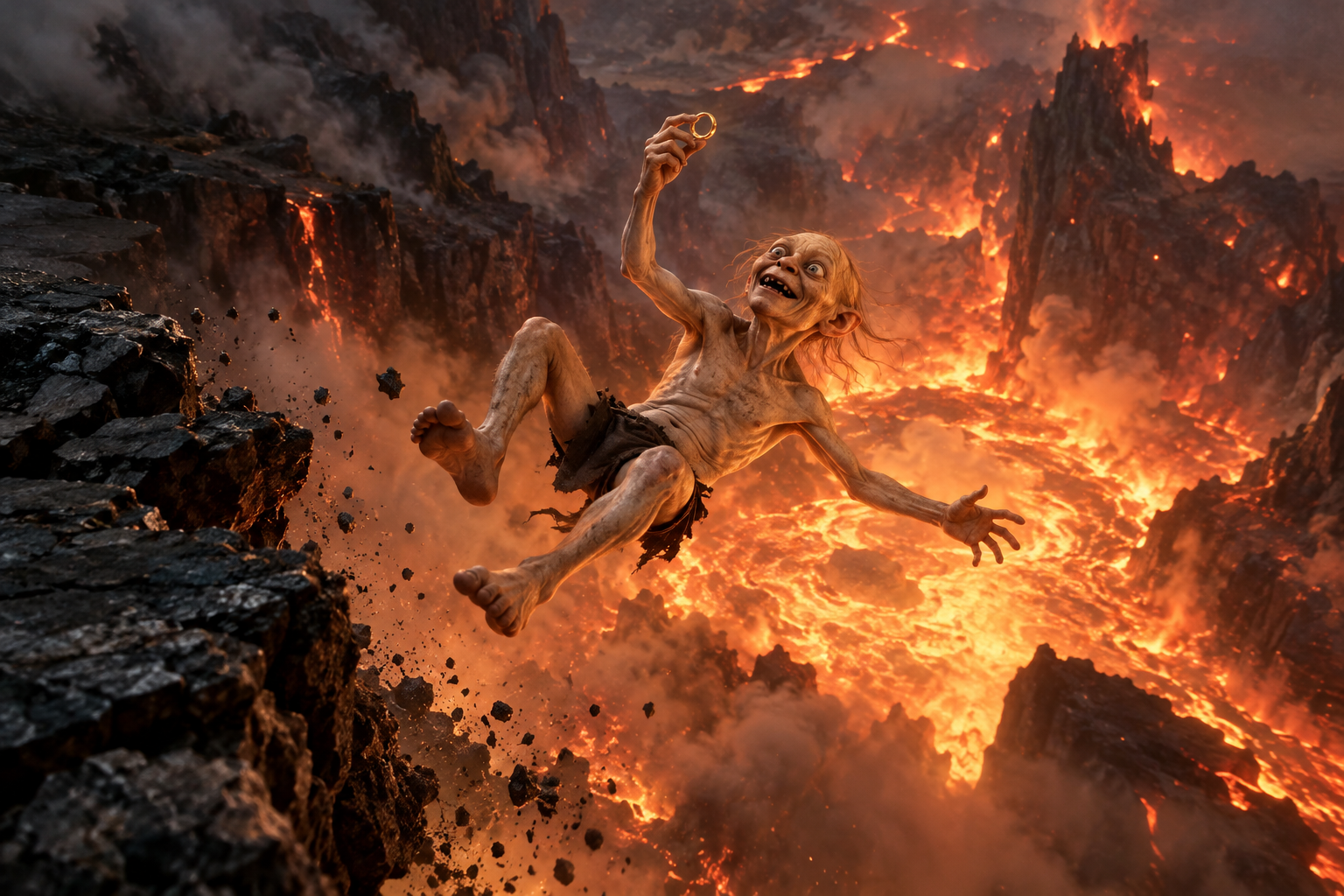
Then Gollum emerges from the shadows. Driven by the same desperate craving that has governed his existence for centuries, he attacks Frodo and seizes the Ring. For one ecstatic moment, his Precious is his again, and in the wild joy of possession, he loses his footing and falls into the fire. The Ring is destroyed, Sauron’s power collapses, and Middle-earth is freed from the darkness that threatened to consume it.
What a strange and beautiful paradox. The creature most enslaved by the Ring becomes the unwitting instrument of its destruction. The one who could not release his craving brings about the end of the very object that sustained it. And Frodo’s compassion, which at times seemed to accomplish so little, helped make this ending possible. Had Gollum been killed, had Frodo refused to see the suffering being beneath the frightening creature, the Ring might never have reached the fire. The story offers no comfortable certainty that love will always be understood, that compassion will always be returned, or that freedom unfolds along a predictable path. Instead, it reveals something more mysterious: our lives are woven together in ways we cannot fully comprehend; our actions ripple outward beyond our understanding; and sometimes what appears to be failure becomes part of an unfolding we could never have anticipated.
Yet, perhaps the deepest question is not why Gollum could not surrender the Ring, or why Frodo himself ultimately succumbed to its power. Perhaps the deeper question is why Tom Bombadil never needed it. What did Tom understand, or perhaps simply embody, that Gollum had forgotten, that Sauron could not imagine, and that even Frodo struggled to remember? I understand as that nothing we can possess will make us whole, because Wholeness is not something we acquire. It is the underlying nature of our existence, the quiet belonging we have never truly left. The Ring promises completion through possession, while Tom reveals belonging without possession. Gollum suffers because he believes something essential is missing. Frodo suffers because even compassion does not entirely free him from attachment. Sam suffers because love, when entangled with fear, can become guarded against the very vulnerability that makes a relationship possible. And Sauron seeks to dominate the world because he has mistaken control for security.
Each reveals a different relationship to the same fundamental illusion: the belief in separation. The belief that we are isolated beings who must secure our existence against a world outside ourselves. The belief that we can find what we most deeply long for by acquiring, controlling, defending, or becoming. Yet what if this belief is itself the source of so much of our suffering? What if the sense of incompleteness that drives our endless striving is not evidence that something is missing, but evidence that we have come to misunderstand who we are? And what if freedom does not require us to become someone else, but to see through the stories that have convinced us we are separate from life?
These are not merely questions raised by a work of fantasy. They lie at the heart of some of humanity’s oldest contemplative traditions. From a cultural perspective, it is easy for human beings to not see the world not simply as it is, but through the movements of thought, memory, desire, fear, and identification. When we mistake those movements for the whole of reality, we become entangled in a world of apparent separation. Reality then appears as a multiplicity of separate forms, as if there is an inner and outer, perceiver and perceived, observer and observed.
Maya does not ask us to deny the world, dismiss suffering, or turn away from existence's astonishing beauty and complexity. Rather, it invites us to question whether the boundaries we experience between ourselves and the living world are as absolute as we have been taught. It asks us to consider that our thoughts about reality may not be reality itself, that the identities we defend may be far smaller than the life we actually are, and that the wholeness we seek may already be present beneath the stories that obscure it.
Perhaps this is what Tom Bombadil, singing beneath the ancient trees, offers us as an image of another way of being. Not a life without pain, uncertainty, or change, but a life no longer organized around the desperate need to become complete. A life in which the rivers, the forests, the birds, and the turning seasons are not objects standing apart from us, but expressions of the same living mystery to which we belong.
Maybe, if we listen deeply enough, we may begin to hear something of that song within ourselves. A song older than our fears, older than our stories, older even than the names we have learned to call ourselves. A quiet remembering that what we have spent our lives searching for was never truly missing, and that what we have struggled so desperately to become may be what we have always been. The ever-present, eternal OMH that is at the heart of us all.
The Wholeness that was never lost.
And to Love: the expression of our return back home to Wholeness.
